

In the world of web development, unhandled errors are silent threats. They can degrade user experience, cause unpredictable application behavior, and leave developers in the dark. For years, Angular's error handling has benefited from a bit of "magic" provided by Zone.js. However, as the framework evolves towards a more explicit and performant zoneless future, that magic disappears, requiring a new approach. This is the primary reason provideBrowserGlobalErrorListeners was introduced. It’s not just a new feature of the Angular v20, but a fundamental tool for robust error handling in modern, zoneless Angular. But lets start from the beginning.
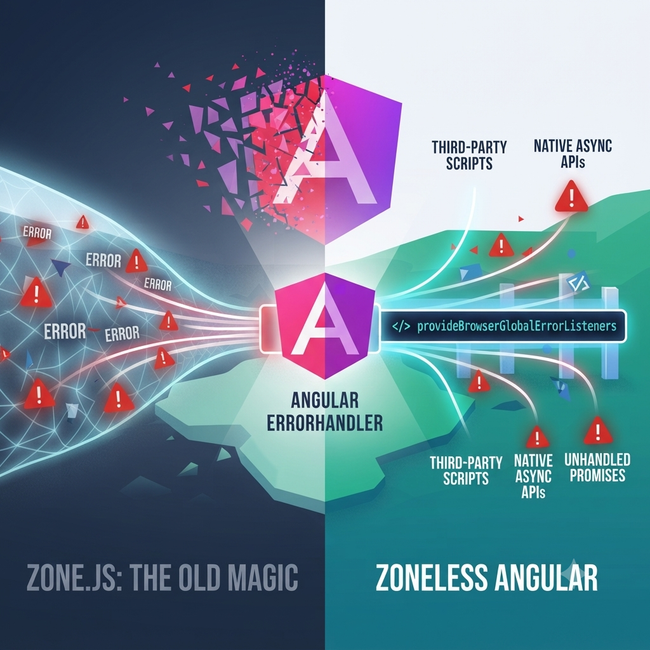
Error Handling with Zone.js: The Old Magic
In a traditional, "Zone-full" Angular application, Zone.js acts like an invisible net cast over our application's execution context. It works by "monkey-patching" nearly all standard asynchronous browser APIs, such as setTimeout, addEventListener, and, critically, Promise.
Because Zone.js wraps these APIs, it gains awareness of almost every async task that begins and ends. This mechanism is primarily used to trigger Angular's change detection automatically. However, it provides a powerful side effect for error handling:
- Automatic Interception: When a
Promiseis rejected without a.catch()handler,Zone.js's patched version ofPromiseis aware of this failure. It automatically intercepts the unhandled rejection and forwards it into Angular's execution context. - Centralized Errors: The result is that these "outside" errors are seamlessly channeled to Angular's central ErrorHandler, where they can be processed just like an error from a component or service. The
ErrorHandleris a simple, injectable class that serves as a centralized hook for all exceptions caught within the Angular framework. Its default implementation is straightforward. You can read more about it in the Armens's article about Angular Error Handling
This was convenient, but it relied on the implicit, pervasive nature of Zone.js.
The Zoneless Challenge: When the Magic Disappears
A zoneless application, by definition, does not include Zone.js. This brings significant performance gains and makes application behavior more explicit, but it removes the invisible error-catching net.
So what happens when an error occurs outside of Angular's direct control in a zoneless application? Consider these common scenarios:
- Unhandled Promise Rejections: A
Promiseis rejected somewhere in our code, but we forgot to chain a.catch()handler. - Third-Party Scripts: An error occurs inside a non-Angular, third-party library that manipulates the DOM or performs its own asynchronous tasks.
- Asynchronous Operations: A callback passed to a native browser API like
setTimeoutor an event listener added withaddEventListenerthrows an error.
Without a specific mechanism in place, these errors would not be intercepted by Angular's ErrorHandler. They would be logged to the console but would exist outside our centralized error-handling logic, making them invisible to our logging and reporting services.
The Solution: Building a Bridge with provideBrowserGlobalErrorListeners
This is precisely the problem provideBrowserGlobalErrorListeners solves. It serves as the explicit replacement for the implicit magic that Zone.js once provided for error handling.
Instead of patching anything, this provider sets up simple, native event listeners on the global window object for:
- error: Fired for general runtime script errors.
- unhandledrejection: Fired whenever a
Promiseis rejected without a handler to catch the rejection.
When one of these global events is triggered, the listener created by provideBrowserGlobalErrorListeners intercepts the raw error and **forwards it to Angular's centralized ErrorHandler class.
This re-establishes the connection that was lost when Zone.js and creates a unified pipeline, ensuring that errors from third-party scripts, native browser APIs, or unhandled promises are treated the same as errors from within our components or services. This allows us to process every error in one central location, whether for logging, analytics, or displaying user-friendly notifications.
This function is a default part of the Angular's setup. When we create a new project using the Angular CLI, the provideBrowserGlobalErrorListeners() provider is automatically added to the app.config.ts file, ensuring that robust error handling is built-in from the very beginning.
export const appConfig: ApplicationConfig = {
  providers: [
    provideBrowserGlobalErrorListeners(),
    // ...
  ]
};
Implications for Testing
This improved error capturing has an important consequence for testing. Errors thrown in event listeners are now reported to the internal Angular error handler. This is a positive change for application quality, as it means we may see errors in our tests that were not reported before, uncovering previously hidden bugs.
The recommended approach is to fix the underlying issues causing these errors in our tests. However, if that's not immediately feasible, we have an escape hatch. We can configure the TestBed to prevent these errors from failing our test suite by setting rethrowApplicationErrors: false in the configureTestingModule setup as a last resort:
TestBed.configureTestingModule({
  // ... other testing module configuration
  rethrowApplicationErrors: false, // Use only when necessary
});
Customization and Best Practices
The Angular team recommends handling these global errors for most applications, and provideBrowserGlobalErrorListeners is the easiest way to do so. It offers a "plug-and-play" solution that integrates seamlessly with the framework.
However, Angular remains flexible. If our application has specific needs that require a different approach, we are free to implement our own custom listeners for the window.error and window.unhandledrejection events. If we choose to provide our own custom listeners, we can, and should remove provideBrowserGlobalErrorListeners from our app.config.ts providers to avoid setting up redundant handlers.
Conclusion
provideBrowserGlobalErrorListeners is a valuable and effective utility for Angular developers. It offers a consistent way to catch errors that occur outside the Angular context, seamlessly integrating them into Angular’s error handling flow. As Angular continues to evolve, the importance of explicitly managing and handling errors becomes even more important. By leveraging provideBrowserGlobalErrorListeners and custom ErrorHandler implementations, we can create Angular applications that are more robust, stable, and user-focused.

